 English
 Français
News
Home / News / Industry News / Beeswax vs Paraffin Wax: Burn Time, Scent Throw, Cost and Sourcing Facts
Content
Every few weeks our inbox gets a version of the same message: a buyer has two sample candles on the desk, one poured in beeswax and one in paraffin, and needs to know which one belongs in their next collection. It is a fair question, and after sourcing, blending and packing both materials for customers across North America, Europe and the Middle East, we have learned that the answer has far more to do with the product than with the wax.
Beeswax and paraffin wax are not really rivals. They are two different tools, each with a personality shaped by where it comes from, how it behaves in a melter and how it reads on a label. Here is how we usually walk a customer through the comparison.
Beeswax is a secretion that honeybees use to build comb. Once filtered, it ranges from pale cream to deep golden amber, carries a faint honey sweetness, and hardens into a dense, slightly tacky block. It is renewable in the truest sense, but supply is tied to colony health and weather, so volumes tighten in poor seasons and prices move with them.
Paraffin wax is separated from petroleum during refining. Fully refined paraffin, the grade used in candles, is odourless, colourless and remarkably consistent from batch to batch. That consistency is why it became the backbone of the mass-market candle industry: a factory in one country can match the burn of a factory in another without reformulating.
Beeswax has a higher melting point, usually somewhere around 62 to 65°C, and a denser crystal structure. In practice, a beeswax candle of a given weight tends to burn noticeably longer than the same candle poured in paraffin. Suppliers often quote two to three times the burn time; in our own side-by-side tests the gap is usually smaller than that but still clearly visible, especially in pillars and tapers.
The flame looks different too. Beeswax gives a warm, bright flame with a slight golden cast and a soft honey note in the melt pool. Container paraffin, with its lower melting point, produces a gentler flame that some buyers describe as less brilliant, though wick choice and vessel geometry matter more than most people expect.
This is where paraffin holds a clear advantage. Its open structure accepts fragrance oil readily, and it delivers both a strong cold throw, the scent you notice before lighting, and a reliable hot throw once the pool forms. For a fragrance-led line where the scent has to reach across a room, that matters.
Beeswax is denser and needs more oil and a warmer melt to carry a comparable load, and its natural honey note can either enhance or fight a fragrance. It sits beautifully under amber, vanilla, tobacco, cedar and warm spice accords, but it can muddy a crisp citrus or a delicate white floral. Many of our customers solve this with a blend, pairing beeswax with soy or coconut wax to keep the natural story while improving throw. If you are still mapping the wider wax landscape, our note on soy wax vs paraffin vs coconut wax picks up where this comparison leaves off.
The table below is the short version we send to buyers who need something they can forward internally.
| Aspect | Beeswax | Paraffin |
|---|---|---|
| Origin | Secreted by honeybees; renewable | Refined from petroleum; finite |
| Melting point | About 62 to 65°C | Roughly 46 to 68°C by grade |
| Burn time | Longer per gram; often 1.5 to 3 times paraffin | Shorter but highly predictable |
| Fragrance load | Needs more oil; natural honey note | High load; strong cold and hot throw |
| Colour and finish | Cream to amber; natural texture | White, opaque, easy to dye |
| Cost per kilogram | Highest of the common waxes | Lowest of the common waxes |
| Typical fit | Premium, gift and natural positioning | Volume, price-led and fragrance-led lines |
Cost is usually the first slide in any buyer presentation, and here the difference is stark. Paraffin is the cheapest candle wax on the market and supply is stable all year round. Beeswax costs several times more per kilogram and its availability fluctuates with the beekeeping season.
That gap does not automatically favour paraffin. A beeswax candle can justify a premium shelf price, and the longer burn time means the end customer gets more hours out of every gram. Where paraffin wins is in the volume business: large retail programmes, private label basics and seasonal gift sets built to a tight target cost. A fully refined paraffin like the one below is the workhorse for exactly that kind of programme.
 Fully Refined Paraffin Candle Wax for Volume ProductionA workhorse fully refined paraffin for private-label basics and seasonal gift sets, available in four grades suited to different candle-forming methods.View Product →
Beeswax is viscous when melted and generally needs a larger wick than paraffin for the same jar diameter. Square braid cotton is the traditional pairing because it opens as it burns and keeps up with the denser fuel. Paraffin is more forgiving: a standard pretabbed cotton wick often works with only minor sizing adjustments, and wooden wicks perform well in paraffin blends because the wax pool stays softer.
Paraffin shrinks as it cools and frequently pulls away from a glass vessel, which is why so many container candles are double-poured or heat-gunned. Beeswax shrinks less at the wall but can sink or crack at the centre, so it rewards a warm, slow cool and occasionally a top-up pour. If you are switching waxes inside an existing vessel, always retest: the same wick and the same pour temperature will not behave the same way in both materials.
These are the scenarios we see most often, and the way we usually answer them:
Sculptural work is a good example of how the material shapes the design. A natural beeswax artist candle, poured in a wood-stump form, sells the material itself as much as the fragrance.
 Wooden Stump Natural Beeswax Artist CandleA sculptural beeswax aromatherapy candle with a crackling wooden wick and six scent styles, suited to decorative, nature-inspired interiors.View Product →
Most of our customers do not want to choose one wax forever. They want a supplier who can hold both, ship both and blend both without a second purchase order. Our raw material range covers fully refined paraffin, grade A white beeswax, yellow beeswax and beeswax pellets, alongside soy flakes, coconut wax, pillar blends, cotton and wooden wicks, vessels and fragrance oils.
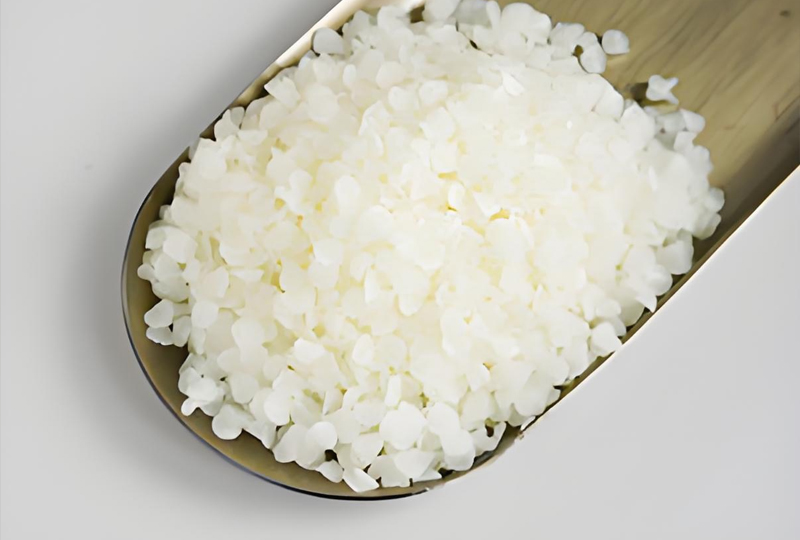 Granular Grade A White Beeswax Candle WaxA granular white beeswax for hand-rolled, carved and formulated candles, blending readily with other waxes for bright decorative pieces.View Product →
That mix matters at the development stage. A brand can test a paraffin version and a beeswax version of the same vessel, compare the burn data, and only then commit to a mould, a label and a fragrance load. Because we sit between the wax, wick, vessel and oil suppliers rather than inside a single factory, we can adjust one component without rebuilding the whole bill of materials.
If you need the finished product rather than the material, our custom candle development service covers wax selection, wick sizing, vessel choice, fragrance matching and packaging, with samples before any production run.
So which one should you choose? If your customer is buying on price and volume, paraffin remains hard to beat, and modern fully refined grades burn cleanly when they are wicked correctly. If your customer is buying a feeling, a story or a gift, beeswax earns its premium through longer burn time, a warmer flame and a material that needs no marketing spin.
And if you are genuinely unsure, the answer is often both: one line in each, tested side by side in the same vessel, with real burn data in front of you before the purchase order goes out. That is a conversation we are always happy to have.

Room 1701, Building C1, Wangjing, Xiaoshan District, Hangzhou City, Zhejiang Province, China.

+86-15937257616

Copyright© 2026 Hangzhou Leo Home Trading Co., Ltd. All Rights Reserved.

Luxury Candles Home Fragrance Manufacturers Modern Candles Factory