 English
 Français
News
Home / News / Industry News / Australian Guidelines for Candle Packaging: A Supplier's Compliance Guide
Content
Packaging a candle for the Australian market is a compliance project as much as a design one. Importers, wholesalers and retail buyers down under tend to ask the same three questions before they raise a purchase order: will this pack meet local expectations, will it survive the freight leg, and will it work on the shelf and in the recycling bin? From our side of the table, Australia is one of the markets where the packaging brief is written before the product brief.
The notes below summarise what we have learned about the Australian guidelines that shape candle packaging, written from the supply side of the table. Treat them as a planning tool rather than legal advice, and confirm final label wording with your importer or legal adviser before artwork goes to print.
Australia does not currently have a candle-specific mandatory safety standard. Candles sold to consumers sit under the general safety provisions of the Australian Consumer Law, which require goods to be safe for their normal use. That is not an empty requirement: the ACCC can investigate a product, require a recall, or ban a design outright when it proves unsafe.
Several neighbouring regimes catch new candle suppliers by surprise, and each one leaves a mark on the packaging:
Most Australian buyers send a label checklist with their first enquiry, and those lists overlap heavily. Here is what we are asked to print most often.
| Label element | Why it matters | Where it belongs |
|---|---|---|
| Product and fragrance name | Identifies the SKU on shelf and in any recall notice | Front of carton or lid |
| Net weight in grams | Must match the packed content for trade measurement | Front panel |
| Safety warnings | Shows that risks have been disclosed with the product | Vessel base or label, repeated on the carton |
| Batch or lot code | Allows a single production run to be traced and scoped | Base label and carton flap |
| Importer name and Australian address | The importer becomes the supplier of record in Australia | Back or side panel |
| Country of origin | Origin statements must be accurate and defensible | Back or side panel |
| Disposal or recycling instructions | Supports kerbside sorting and retailer packaging reporting | Base or back panel |
| Barcode | Needed for retail scanning and stock control | Back panel |
Warning wording usually starts from one of three sources: the EN 15494 label set used across Europe, the ASTM F2417 safety specification used in the United States, or a retailer's own house standard. Whichever starting point you choose, a practical Australian warning set covers these points:
One point we raise on almost every project: print the warnings on the vessel, not only on the carton. The box is usually in the recycling bin within minutes of the first burn, which is exactly when the safety copy starts to matter. A lidded vessel such as our embossed matte white lidded ceramic jar candle gives you a flat base and a clean lid surface for that wording, and the lid keeps a printed label protected in transit.
 Embossed Matte White Lidded Ceramic Jar CandleThe matte white ceramic vessel features embossed geometric detailing, delivering a minimalist yet tactile aesthetic that complements contemporary interiors.View Product →
Australian packaging expectations have tightened year on year. The APCO 2025 National Packaging Targets call for all packaging to be reusable, recyclable or compostable, 70% recycled content across the board, and the phase-out of problematic single-use plastics. That is why expanded polystyrene inserts, PVC windows and loose plastic void fill have become awkward choices for a candle sold into Australia, and why national packaging design obligations are moving from voluntary targets toward mandatory requirements.
State and territory single-use plastics bans add a second layer, because they cover items that regularly sit inside a candle box. Moulded pulp trays, paper honeycomb, corrugated inserts and tissue wrap are now the default inner packaging across most of the projects we run. On the outer pack, mono-material folding cartons, water-based inks and certified board keep the pack inside the kerbside recycling stream, while heavy foil lamination and mixed-material rigid boxes generally push it out.
Three habits make the difference in practice:
Gift sets are the hardest case, since they combine several materials in one box. A set with an outer sleeve, an insert tray and two glass vessels needs a disposal route printed for each part, and the tray has to hold the vessels firmly enough that they never touch each other.
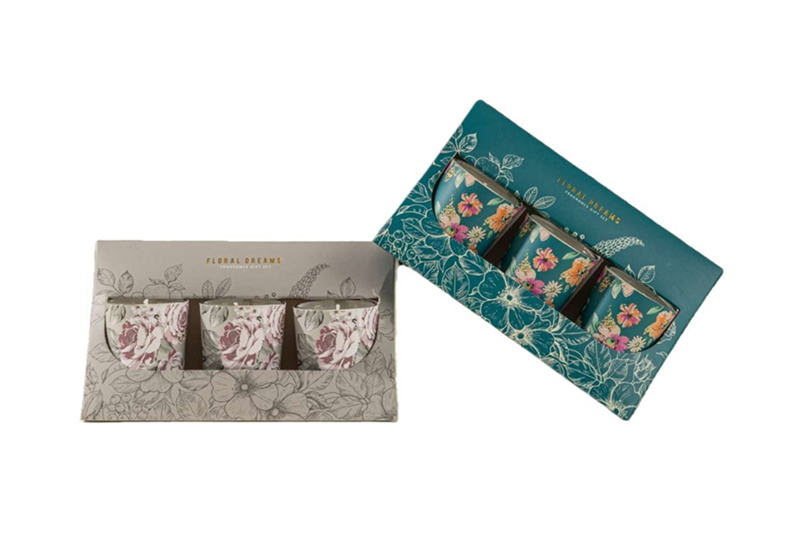 Floral Glass Tealight Candle Set Gift BoxThe Floral Glass Tealight Candle Set Gift Box combines elegant design with a warm, relaxing atmosphere. Each candle is housed in a beautifully decorated glass holder f...View Product →
Sea freight to Sydney or Melbourne means weeks of humidity, stacking pressure and container heat. The failures we see most often are wick deformation in soft wax, scuffed wax surfaces where a jar rubs its neighbour, and cracked glass at the shoulder when an inner box has no corner clearance.
Australian buyers also notice the small things. A carton that opens without a knife, a lid that doubles as a burning platform, or a label that stays flat on a curved jar all signal that the supplier has done this before.
Adhesive choice is where many candle labels fail. Cement and unglazed ceramic are porous and need a stronger, more forgiving adhesive. Glazed ceramic and glass are smooth and low in surface energy, so they need a clean substrate and a label built for it. Matte finishes hide fingerprints but show glue residue, which is why many brands print the base copy directly and reserve the label for the fragrance story.
Send your supplier die lines, artwork files and a mock-up request early. Checking artwork on a real jar, at real size, catches problems a PDF preview never shows: warning text that wraps awkwardly on a curved surface, a barcode placed where the hand will cover it, or a batch code printed on a surface that is later wrapped in film.
Batch control deserves the same attention. A supplier who finds a safety issue has to act on it, and regulators expect a recall to be scoped to specific production runs. A lot code printed on both the base label and the carton flap turns a market-wide problem into a traceable one, and it is far cheaper to design in than to add later.
For OEM and ODM work, most brands arrive with a fragrance direction and a target retail price. A clear glass candle jar with a bamboo lid is a common starting point, because the label, wax colour and lid finish can all change without new tooling.
 Clear Candle Glass Jar with Bamboo LidThe Clear Candle Glass Jar with Bamboo Lid features a minimalist cylindrical glass body paired with a natural bamboo lid, creating a clean and modern container ideal f...View Product →
Australian candle packaging is not one rule but a stack of them: general consumer safety, battery and dangerous goods provisions, honest origin and environmental claims, and the practical reality of a pack that travels thousands of kilometres and still looks good on a shelf. Getting the label, the insert and the batch code right at the design stage costs almost nothing. Fixing them after a container has landed costs considerably more.
If you are developing a candle or diffuser range for Australia, we are happy to talk through vessel options, label layouts, packaging materials and lead times. You can see the full spread of scented candles, diffusers and candle accessories in our home fragrance catalogue, or send us your brief and we will come back with samples and a packaging proposal.

Room 1701, Building C1, Wangjing, Xiaoshan District, Hangzhou City, Zhejiang Province, China.

+86-15937257616

Copyright© 2026 Hangzhou Leo Home Trading Co., Ltd. All Rights Reserved.

Luxury Candles Home Fragrance Manufacturers Modern Candles Factory